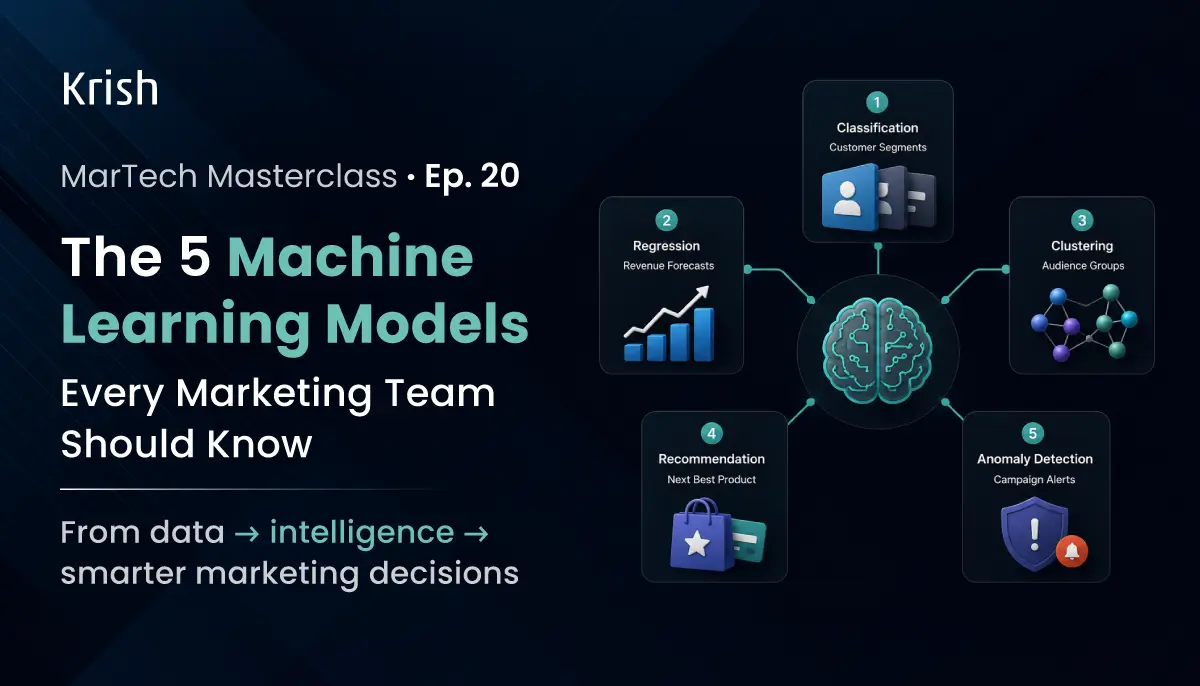
The Mistake of Considering ML as a Single Thing
Most marketing conversations about machine learning (ML) collapse it into a single capability. Teams talk about “using AI” or “adding ML to the stack” as though it were one tool with one function. It is not, and treating it that way is why most ML initiatives either overreach and fail or underdeliver and disappoint.
ML is a family of techniques, each structurally different, each built to answer a different kind of question, each requiring different data, and each connecting to a different part of the commercial operation.
Last week, in episode 19, we drew the line between hindsight and foresight: between a stack that describes what already happened and one that anticipates what’s next. Here’s the part nobody says out loud.
The models that produce foresight are already sitting inside the tools you pay for. GA4 ships predictive audiences. Your email platform scores propensity. Your commerce platform recommends products out of the box. The five most important marketing ML models are not locked behind some future “AI transformation.” You own them today.
So why do most marketing teams still run on hindsight?
Because owning a model and being able to use one are different things. A model is only as good as the data feeding it and the order you switch it on in. Most teams get both wrong: they light up the flashiest model first, starve it of unified data, and end up with five half-working engines instead of one system that compounds.
This isn’t a list of five tools. It’s five questions a customer relationship asks, in order, and the map of where yours goes dark.
Five questions, one lifecycle
Stop shopping for models. Start with the questions a relationship actually asks as it moves from first click to churn risk, and notice that each answer sets up the next:
- Who’s ready? – propensity to buy
- What do they want? – recommendations
- Who’s worth pursuing? – lifetime value
- How do they feel? – sentiment
- Who’s leaving, and when? – churn
Instrument them in sequence, and each model feeds the next. Skip a stage and you don’t just lose one capability; you create a stretch of the lifecycle where you’re flying blind. Call it the foresight gap. It’s almost always in the middle and back of the journey, exactly where the profit lives.
The 5 ML Models Built for Marketing and What They Do
The five ML models that deliver the most consistent commercial value for marketing teams are propensity to buy, product recommendation engines, LTV (Lifetime Value) prediction, sentiment analysis, and churn prediction. Each one is covered below: what it does mechanically, what data it requires, where it breaks, and what it connects to in the customer journey.
1. Propensity to buy
A propensity-to-buy model is a scoring model that ranks every customer or prospect in the current population by their probability of making a purchase within a defined time window.
It answers, “Who’s ready to convert right now?”
What feeds a propensity model:
- Product page visit frequency and depth within a defined session window
- Search query specificity, including searches for size, variant, or delivery details
- Add-to-cart and wishlist activity without conversion
- Return visits to the same product or category across multiple sessions
- Email click-through on product-specific content versus category-level browse
- Historical purchase velocity: how quickly this customer has converted from consideration to purchase before
How it changes campaign economics:
The commercial logic is straightforward. A fixed campaign budget distributed equally across all active customers produces lower aggregate conversion than the same budget concentrated on customers the model identifies as high-propensity. The model does not increase the size of the audience. It increases the precision of which part of the audience receives which investment at which moment.
GA4’s native purchase probability scoring is the most accessible implementation of propensity modeling for most ecommerce businesses. It runs on behavioral event data already flowing through the property and requires no custom model development, with the only prerequisite being a correctly configured GA4 ecommerce implementation. The audience output can be activated in Google Ads for bid adjustment or exported to a CDP for campaign targeting immediately.
Ranks every prospect and customer by near-term likelihood to purchase, so budget flows toward people already leaning in, not sprayed across a cold list. Done right, it reshapes the funnel: fewer touches, higher conversion per touch, lower cost per acquisition.
- Reads intent signals: search behavior, repeat visits, cart activity, engagement velocity
- Its only job is to trigger the right message at the right moment
Further reading
How The Perfect Water Unified Omnichannel Marketing to Drive Conversions, Multichannel Engagement, and Revenue Growth
Where it breaks: intent is perishable. A score parked in a dashboard is inert. It has to feed marketing automation, and it has to be retrained faster than your market moves.
2. Recommendation engines
A product recommendation engine is not a single algorithm. It is a class of models with several technically distinct approaches, each suited to different data availability and catalog structures.
It answers, “What does this customer want next?”
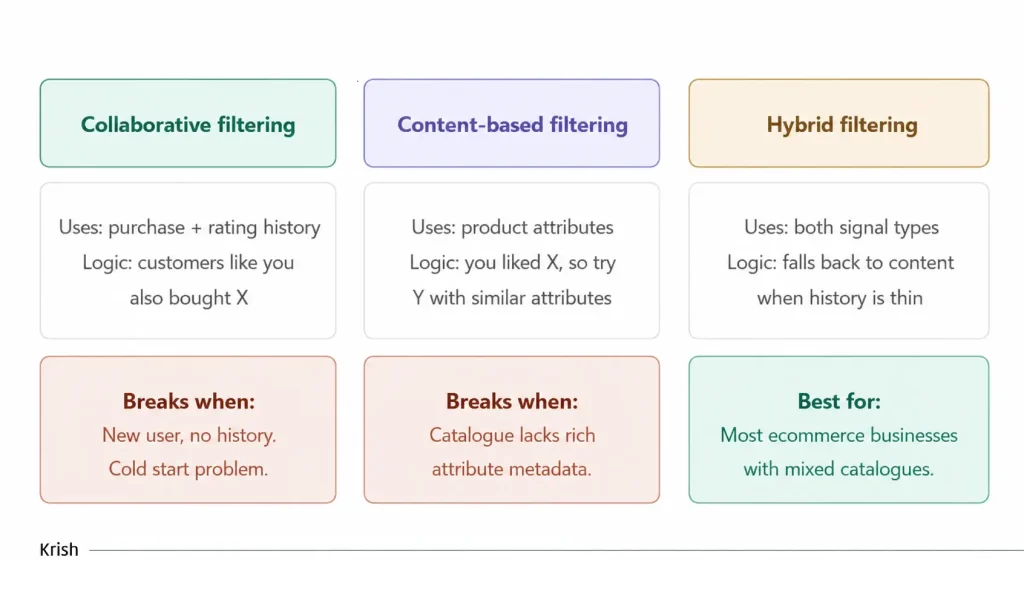
Collaborative filtering finds patterns in the purchase and interaction history of large populations of users to identify what customers with similar behavioral profiles tend to buy. It does not need to know anything about the products themselves. It needs only to know what customers have done. The well-known “customers who bought X also bought Y” pattern is collaborative filtering at its simplest. Its weakness is the cold start problem: for a new user with no history, collaborative filtering has no behavioral profile to match against and cannot produce a meaningful recommendation.
Content-based filtering sidesteps the cold start problem by looking at product attributes rather than user history. If a customer has engaged with a specific type of product, category, or brand, the model recommends products with similar attribute profiles. Its weakness is the opposite of collaborative filtering: it depends on rich, consistent product attribute metadata. A catalog with thin or inconsistent product data cannot produce meaningful content-based recommendations regardless of model sophistication.
Hybrid filtering combines both approaches, using collaborative filtering when behavioral history is available and falling back to content-based signals when history is thin. This is the appropriate choice for most ecommerce businesses with mixed catalog sizes and customer cohorts at varying lifecycle stages.
As Krish’s AWS AI/ML analysis describes, personalized product recommendations use purchase history and behavioral analysis to create individual recommendations that increase average order value, enhance customer lifetime value, and facilitate shopping experiences that drive loyalty and repeat purchases.
Where it breaks: fed thin, siloed data, it recommends the thing the customer just bought. Signal quality beats model sophistication. Turning it into a real AI-led solution means clean data and tested placements, not a switch flipped everywhere at once.
3. Customer lifetime value (CLTV)
Predictive LTV is not a historical average. It is a forward-looking revenue estimate per customer, generated from early behavioral signals and trained on the historical relationship between those signals and long-term revenue outcomes across prior cohorts.
It answers, “Who is actually worth pursuing?”
The model takes inputs observable early in the customer relationship: first-purchase category, initial purchase value, days to second purchase, breadth of early product catalog engagement, acquisition channel, and device type, and produces an estimated revenue contribution over a defined horizon, typically twelve or twenty-four months, for each customer individually.
Why this changes acquisition and budget decisions:
When channels are evaluated by the predicted LTV of the customers they produce rather than by immediate conversion rate, the budget allocation decisions change substantially:
- A channel converting at a lower rate but consistently producing high-LTV, low-churn customers has a structurally higher expected return than one converting frequently but producing single-purchase customers
- Average order value (AOV) averages across all customers and all channels obscure this cohort-level variation entirely
- A marketing team without LTV modeling is making channel investment decisions on the basis of the most recent conversion, which is the least predictive signal available
LTV modeling also adds a forward-looking dimension to the RFM (Recency, Frequency, Monetary) segmentation covered in episode 13. A new customer with a low Frequency score but a behavioral pattern that historically preceded high long-term value should receive different investment than a customer with a similar RFM profile but a pattern that historically preceded early churn. Without LTV prediction, that distinction is invisible.
Where it breaks: LTV is exquisitely sensitive to data completeness. Scatter a customer across web, app, POS and three campaign tools and the model is guessing. It lives or dies on a unified customer view.
4. Sentiment analysis
Sentiment analysis is a Natural Language Processing (NLP) classification model that processes unstructured text, such as product reviews, customer support transcripts, social media mentions, and post-purchase survey responses, and assigns each unit of text a sentiment classification: positive, negative, or neutral, sometimes with granular intensity scores per sentiment category.
It answers, “How do customers actually feel, at scale?
The commercial value is not in knowing that a customer left a negative review. That is visible without ML. The value is in processing thousands of reviews, transcripts, and social mentions simultaneously, extracting the specific product, experience, or service attributes driving each sentiment, and surfacing emerging patterns before they reach a volume that triggers a manual escalation.
What sentiment models do that manual review cannot:
- Classify and aggregate feedback across product variants, store locations, or customer segments simultaneously without a human reading each entry
- Detect sentiment shifts in near real time, flagging a spike in negative mentions about a specific product attribute within hours rather than days
- Connect sentiment signals to operational data: a spike in negative delivery sentiment correlated with a specific logistics partner or geographic region is an operational insight that manual review rarely surfaces at speed
As Krish’s AWS AI/ML blog notes, Amazon Comprehend determines key phrases, sentiment, entities, and language patterns from unstructured text without requiring ML expertise, allowing organizations to deploy sentiment analysis into customer feedback workflows without custom model development.
What to do with sentiment output:
Sentiment model outputs are most useful when they feed into a product development or experience design feedback loop rather than into a campaign trigger. A campaign triggered by negative sentiment carries real risk of escalating the very friction it is meant to resolve. Sentiment signals belong in product, operations, and CX strategy reviews, where the patterns they surface can inform decisions made upstream of the customer interaction.
Where it breaks: Sentiment classification is context-sensitive in ways that models handle imperfectly. Sarcasm, domain-specific language, product-specific jargon, and ambiguous phrasing all reduce classification accuracy. A customer review that reads “this is exactly what I expected” is positive in one product category and negative in another. Models trained on general text corpora perform worse on domain-specific language than models fine-tuned on in-category data from your own customer base.
5. Churn prediction
A churn prediction model is a binary classification model. Its job is to assign each active customer a probability score between zero and one, representing the likelihood of churning within a defined future window, typically thirty, sixty, or ninety days. It is trained on labeled historical data: records of customers who churned and customers who did not, with the behavioral signals observed in the period preceding each outcome.
It answers, “Who is about to leave, and when?”
The model learns which combinations of signals, weighted by recency and intensity, most reliably precede churn in your specific context. The output is not a list of customers who have already shown obvious disengagement. It is a ranked list of customers whose current behavioral trajectory closely resembles the trajectories of customers who churned before them, flagged before the disengagement is visible to the naked eye.
What feeds a churn model:
- Session frequency trends across rolling windows (weekly, biweekly, monthly)
- Feature or category breadth: is usage or purchase activity narrowing to a single area?
- Time elapsed since last purchase relative to that customer’s historical repurchase interval
- Support interaction frequency and escalation rate
- Email and push communication engagement decay over successive sends
- Opt-out behavior from transactional as well as promotional channels
None of these signals is individually deterministic. Churn emerges from the combination and its trajectory over time.
Where it breaks: The most common failure is a poorly defined target variable. If the organization has no agreed definition of what constitutes a churn event, the labeled training data reflects multiple competing definitions and the model optimizes toward noise. Is churn a subscription cancellation? Sixty days of inactivity? An explicit opt-out? That definition must be agreed across product, CRM, and finance teams before data preparation begins.
The output of a churn model feeds directly into the segmentation and orchestration infrastructure covered in episodes 13 and 14. A high-risk score is not a report. It is a trigger: a customer whose probability crosses a defined threshold enters a retention sequence automatically, without requiring manual triage.
How the Five Models Connect as a System
These five models are not independent tools. Each produces an output that feeds or enriches the inputs to the others, and the combined system is structurally more valuable than any individual model running in isolation.
- A churn prediction model flags at-risk customers. An LTV model tells you which at-risk customers are worth a meaningful retention investment and which are marginal. Without LTV scoring, the retention spend is undifferentiated.
- A propensity-to-buy model identifies who is ready to convert. A recommendation engine determines what to show them. Without the recommendation model, a high-propensity signal triggers a generic campaign. With it, the campaign delivers the specific product the model predicts they are most likely to buy.
- Sentiment analysis surfaces the friction points and category strengths that inform which products the recommendation engine should prioritize, and which product attributes the churn model should treat as disengagement signals.
- LTV predictions inform which segments the churn model should treat as high-priority retention targets versus marginal cohorts, and which acquisition channels the propensity model should optimize for.
The data infrastructure that makes all five models reliable is the same infrastructure. Clean behavioral event tracking from properly configured GA4. Consistent cross-system governance that eliminates the hidden data gaps that corrupt training datasets. Individual-level event granularity rather than aggregate session rollups. Agreed outcome label definitions across product, CRM, and finance teams.
As Krish’s data science services and AI solutions are designed around this connected architecture, the same foundational investment that enables a churn model also enables propensity scoring, LTV prediction, and recommendation quality. The models are not five separate projects. They are five capabilities built on the same data foundation, and the foundation determines what all five of them are worth.
Finally: The Question Is Not Which Model to Use. It Is Which Question to Answer First
Each of the five models in this episode answers a specific commercial question. Before investing in model development or platform configuration, the right starting point is identifying which question, if answered reliably today, would produce the largest change in commercial outcomes. For most ecommerce businesses with an at-risk customer base and rising acquisition costs, churn prediction answers the most urgent question first. For businesses with a deep catalog and low basket depth, the recommendation engine produces the most immediate revenue leverage.
The priority is not universal. It is determined by the specific gap between where the business is today and where the model output would change what the team does next.
Next week, we explore churn prediction in detail: how to build it, how to validate it, and how to turn a probability score into a retention campaign that saves customers before they even think about leaving.
Table of Content
Subscribe with Us!
Never miss any post, stay tuned!

Ankit helps brands navigate their digital maturity journey by bringing together analytics, CRO, ML, and AI in a practical, business-friendly way. Having worked with global teams across industries, he focuses on simplifying complex MarTech concepts and turning them into measurable outcomes. On weekends, you’ll likely find him deep in a reflective read or sharing a coffee with a client while simplifying MarTech in the most human way possible.
Recommended Reading:
How Great Brands Build Trust Within the First 5 Seconds – Conversion Maturity Series | EP 08
14 July, 2026 Trust does not build gradually on a first visit. It either exists in the opening seconds or the session is already lost. As cited by Nielsen Norman Group, visitors form credibility judgments in as little as 50 milliseconds, and these judgments rarely change even with more time.
Subscribe with Us!
Never miss any post, stay tuned!
Trusted by leading brands


